You're building a product. You know it solves a real problem. But every time you sit down to write a cold email, draft a LinkedIn post, or sketch out a landing page, you're starting from scratch — and it shows.
Generic copy. Inconsistent messaging. A homepage that doesn't match the deck you just sent. The kind of marketing that doesn't look like a company anyone would trust with their budget.
Most founders at this stage think the answer is to hire a marketer, or at least bring on an agency. But if you're pre-revenue or just hitting your first million in ARR, you don't have the budget for either — and even if you did, you'd spend three months onboarding them before they ship anything.
Here's what changed: you can now run a full go-to-market operation — campaigns, content, ads, social, collateral — from one workspace, grounded in your actual product knowledge and styled in your actual brand, without hiring anyone.
What does a solo founder actually need to ship?
The ask isn't complicated. You need to look credible. You need to reach people. And you need to do it fast enough that momentum doesn't die while you're wrestling with Canva templates and wondering if your email subject line sounds like spam.
That breaks down into a few concrete outputs:
- Cold outreach that doesn't get ignored. Email sequences that open, get read, and earn replies — not because you guessed at clever copy, but because the message is relevant and the claim is real.
- Social content that builds your presence. LinkedIn posts, tweets, and occasional Instagram updates that keep your name in front of the people who matter, without eating your entire Tuesday.
- Collateral that closes. A sales deck that doesn't look like a founder made it in Google Slides at midnight. A one-pager you can send after a demo. A landing page you're not embarrassed to link to.
- Ads that actually drive sign-ups. Google Ads copy and banners that don't burn budget on keywords nobody searches, written in a way that matches what your product does.
- A brand people recognize. Consistent colors, fonts, voice, and messaging across every channel, so you don't look like three different companies depending on where someone finds you.
You don't need a marketing department to produce these. You need a system that knows your product, understands your brand, and can generate all of it from one place.
What one workspace covers
LaunchPad is built around a simple idea: if the platform knows what your product does and how you talk about it, it can write and design everything else. Here's the structure that makes that possible.
Your Brand Kit: the single source of truth
Set your voice, tone, colors, fonts, logo, and the phrases you always use (and the ones you never touch). Everything generated after that point inherits it automatically.
A Brand Kit also learns your design language — upload a deck or one-pager you like, and LaunchPad extracts your visual style and applies it to new assets. So the sales proposal you generate next week doesn't just use your colors; it looks like your work.
That's what "on-brand by default" means. You're not re-entering your brand guidelines every time. You set it once; the system remembers.
Your Knowledge Base: what the AI writes from
Upload your product docs, pitch decks, feature specs, competitor research, pricing sheets — anything that explains what you built and why it matters. This becomes the intelligence layer behind every piece of content.
When LaunchPad writes an email or generates a landing page, it pulls from these documents. If a claim isn't supported by something in your Knowledge Base — a customer quote, a feature list, a performance stat — it gets left out rather than invented. No invented stats, customers or pricing. No generic filler.
The AI Planner: from goal to campaign in one step
Describe what you want in a sentence: "Run a cold-email sequence targeting SaaS founders, with LinkedIn posts to build awareness."
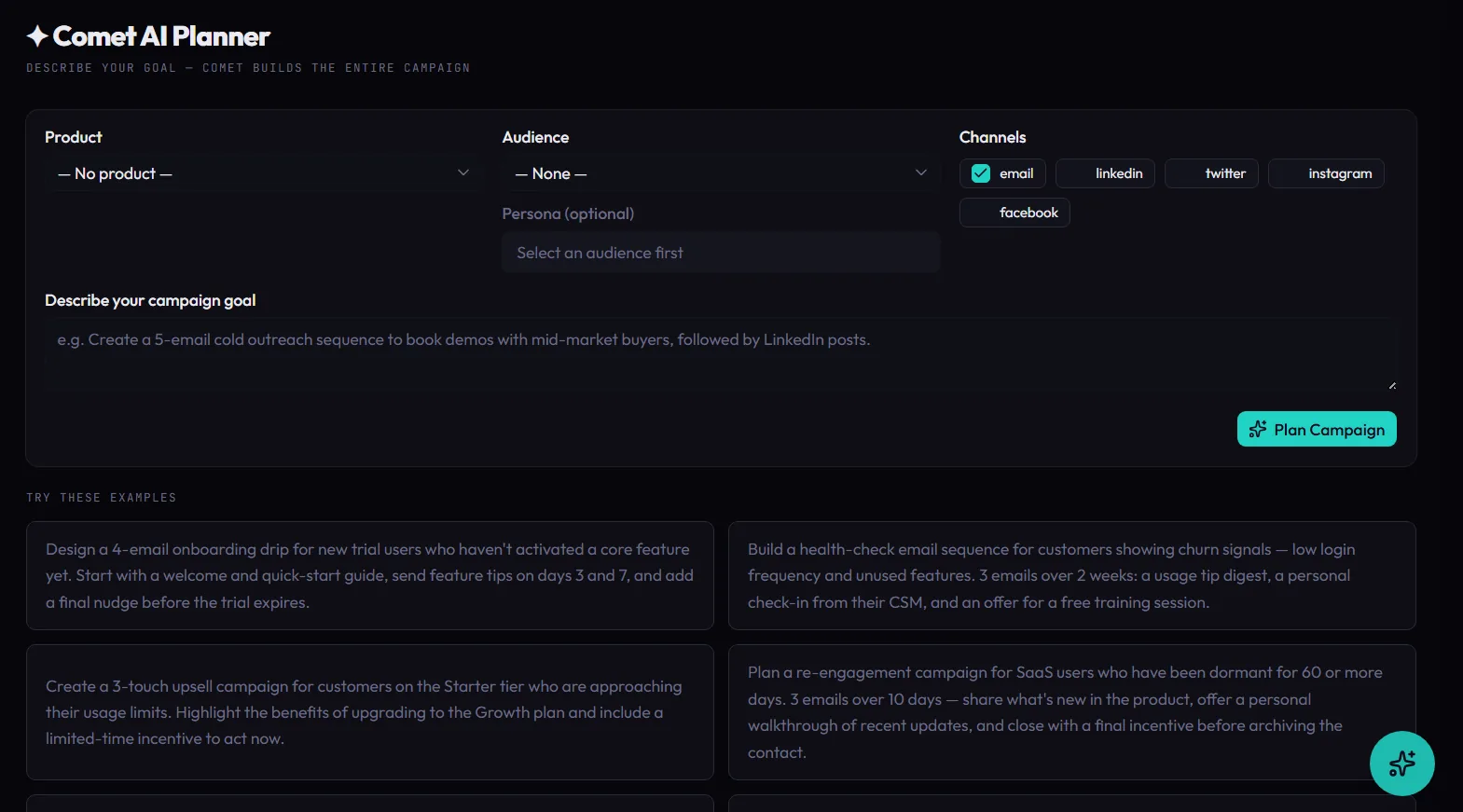
The Planner drafts a complete multi-step campaign — subject lines, email copy, delays, conditional branching, and scheduled social posts — tied to your product and shaped by your brand. You review it, tweak what needs changing, and commit. The whole campaign is built and ready to run.
This is faster than writing one email from scratch. And it isn't just one email — it's the full sequence, the follow-up logic, and the surrounding content, all planned together so they read like one voice.
Execution across every channel, in one place
Once the campaign is live, LaunchPad handles:
- Email sequences with open tracking and conditional branching — if they opened, wait two days then send this; if they didn't, try a different angle.
- Social posts across LinkedIn, Twitter, Instagram and Facebook, scheduled on a shared calendar so you see what's going out and when.
- Google Ads copy and banners, written to your goals and rendered in your brand, with keyword demand scoring so you're not spending on terms nobody searches.
- Landing pages as self-contained HTML files you can host anywhere, generated from your product knowledge and designed to convert.
- Blog posts with SEO metadata and an approval workflow, so you're not publishing drafts by accident.
- Sales decks and battlecards exported as branded PDFs and editable PowerPoint files, skipping slides when your Knowledge Base can't support the claims.
All of it reads from the same Brand Kit and Knowledge Base. All of it lives in one workspace. And all of it gets reviewed by you before it goes out — nothing auto-publishes.
Why this works for a scrappy team of one
Speed is the obvious piece. A campaign that used to take a week — research, copywriting, design, approval rounds, upload to three platforms — now ships in an afternoon. But the bigger unlock is consistency without the overhead.
When you're the only person doing marketing, your messaging drifts. The homepage says one thing, the deck says another, and the cold email you sent last Tuesday doesn't match either. Prospects notice. Investors notice. It looks like you don't know what you're selling yet.
LaunchPad solves this by making your Brand Kit and Knowledge Base the source every asset pulls from. One product description, one set of value props, one voice — and everything generated from it matches. You don't spend mental cycles remembering what you said last time or reconciling three versions of your pitch.
You also don't waste budget on tools that don't talk to each other. Email platform, social scheduler, design tool, landing-page builder, ad manager — those add up fast, and none of them share context. LaunchPad collapses the stack into one workspace, at a price that doesn't assume you have a marketing budget yet.
What you actually get when you start
Here's what "set up and ready to run your first campaign" looks like in practice:
- 1. Set up your Brand Kit. Voice, colors, fonts, logo, tagline. If you have existing collateral, upload it and LaunchPad extracts your design style.
- 2. Add at least one product. Drop in your links or upload docs; LaunchPad reads them and builds your Knowledge Base. This is what every future generation pulls from, so the better the input, the sharper the output.
- 3. Define an audience. Upload a CSV or manually add contacts, then create an Audience card. LaunchPad can suggest personas from the data — without ever sending raw contact records to the AI — and tailor messaging per segment.
- 4. Generate a campaign with the AI Planner. One-sentence goal. Pick your product, your audience, your channels. Review the plan, tweak it, build it. Your first campaign is ready to execute.
That's the onboarding. Four steps, not four weeks. And once it's done, every campaign after that starts from the same Brand Kit and Knowledge Base, so the second one is faster than the first.
When you're ready to grow, the system grows with you
Solo founders don't stay solo forever. When you do hire — a contractor, a co-founder who handles growth, your first marketing person — they inherit a system that already works.
Your Brand Kit becomes the onboarding doc. Your Knowledge Base is the single source of product truth they write from. The campaigns and templates you've already built become the baseline they improve on, not the mess they have to untangle first.
And because LaunchPad tracks what gets opened, clicked and replied to, you're handing them data, not guesses. They know what worked before they write their first line of copy. The platform also supports role-based access and approval workflows, so when you do bring someone on, you can gate what they publish without micromanaging every draft.
The alternative is waiting — or looking like you're waiting
Most early-stage founders do one of three things with marketing:
- Punt it entirely. Build in silence, hope word-of-mouth does the work, and wonder why growth is slow.
- Do it badly themselves. Generic LinkedIn posts, cold emails that don't convert, a landing page that's obviously a template someone used once and forgot about.
- Hire too early. Bring on a contractor or a junior marketer before the product or positioning is stable, burn budget on experiments that don't compound, and reset when the messaging shifts.
None of those get you to credible, consistent and fast. What does work is a system that knows your product, speaks in your voice, and generates launch-ready campaigns across every channel you need — reviewed by you, approved by you, but not built from scratch by you every single time. That's not theoretical. It's what LaunchPad does.
Frequently asked questions
What marketing channels can LaunchPad handle from one workspace?
LaunchPad supports email sequences, LinkedIn, Twitter, Instagram, Facebook, Google Ads, landing pages, blog posts, sales decks and battlecards — all from a single workspace that shares the same Brand Kit and Knowledge Base.
How does LaunchPad prevent AI from inventing fake statistics or claims?
LaunchPad grounds every output in your Knowledge Base — uploaded product docs, pitch decks, feature specs and competitor research. If a claim isn't supported by something in your Knowledge Base, it gets left out rather than invented.
Does LaunchPad auto-publish content or require human approval?
LaunchPad requires human approval for all content. AI drafts everything, but nothing auto-publishes — you review and approve before it goes live.
What is a Brand Kit in LaunchPad and why does it matter?
A Brand Kit is your single source of truth for voice, tone, colors, fonts, logo and approved or forbidden phrases. Once set, every asset LaunchPad generates automatically inherits these elements, keeping you consistent across all channels without re-entering guidelines.
How fast can a founder set up and launch their first campaign in LaunchPad?
Setup takes four steps: configure your Brand Kit, add at least one product to build your Knowledge Base, define an audience, and generate a campaign with the AI Planner. A campaign that used to take a week can ship in an afternoon.