Every marketing team has lived some version of the same failure mode: a campaign goes out with last quarter's logo, the wrong shade of blue, a headline that doesn't sound like the brand anymore. It's rarely carelessness. It's volume — the more a team ships, the harder it gets for any one person to catch every drift before it publishes.
Most AI marketing tools make that problem worse, not better, because they generate content with no memory of what "on-brand" actually means for a given company. Every output starts from a blank page, styled by whatever the model happens to default to that day. LaunchPad is built around the opposite premise: nothing gets generated without first being grounded in what the brand already is and what the product already does.
The standout feature: Brand Kit meets Artifacts Library
The two pieces doing the real work in LaunchPad are the Brand Kit and the Artifacts Library, and they're designed to operate together rather than as separate settings.
The Brand Kit holds the actual definition of what "on-brand" means — colors, typography, tone, voice — the details a style guide usually leaves half-documented because no one has time to write it all down. Once it's set, every campaign, email, social post, or landing page LaunchPad produces gets styled against it automatically. Nobody has to remember to apply the brand. It's not a separate review step — it's the default the content is generated in.
The Artifacts library is where that consistency becomes reusable at scale: more than eighteen branded templates, already styled to the Brand Kit, covering the campaign formats a marketing team actually needs repeatedly — not a generic template pack, but one already shaped around this specific brand's colors, type, and voice. A new campaign doesn't start from a blank canvas and hope the styling lands right. It starts from a template that was already correct and gets adapted to the specific message.
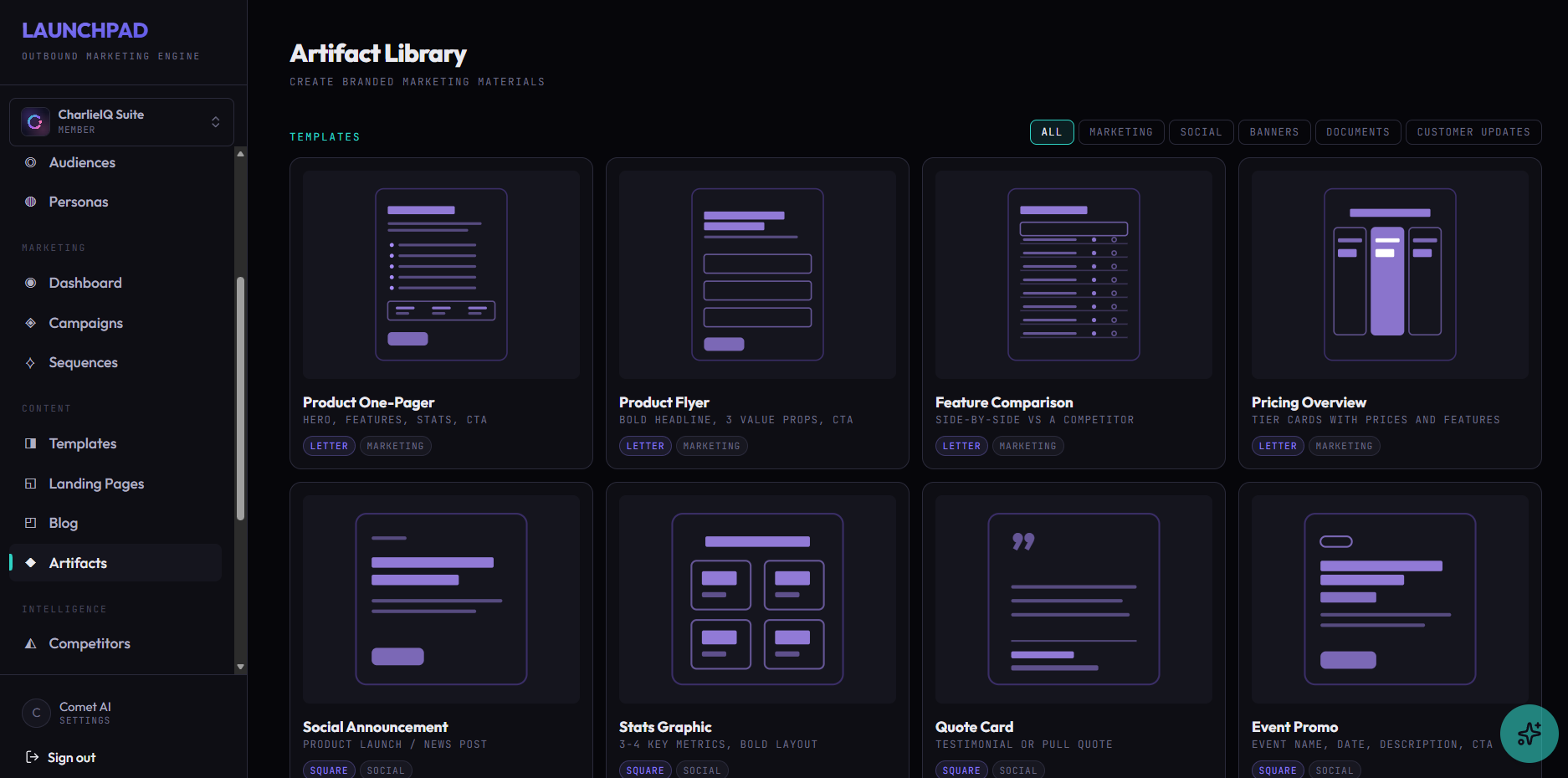
That combination — a defined brand plus a library of formats already built around it — is what separates "on-brand most of the time" from "on-brand by construction." The drift that shows up when volume increases has nowhere to enter, because nothing generates without the Brand Kit already applied.
The other half: grounded in the Knowledge Base, not just styled correctly
Looking right isn't the same as saying the right thing. A campaign can be perfectly on-brand and still misstate a feature, promise something the product doesn't do, or reference a plan that's since changed. That's the failure mode Brand Kit alone doesn't solve — and it's why LaunchPad pairs brand styling with grounding in the Knowledge Base.
Every piece of content LaunchPad produces draws from the same Knowledge Base the rest of the suite reads from — the product's actual capabilities, current messaging, and documentation. That means a campaign isn't just styled correctly; it's factually anchored to what's actually shipped, not to a marketer's memory of what shipped three releases ago. Pair that with the cross-team context CharlieIQ runs on, and a LaunchPad campaign announcing a new feature is describing the feature Minions actually merged — not a guess at what engineering might have built.
What that foundation supports, in practice
Once brand and product knowledge are handled as defaults rather than manual steps, the range of what LaunchPad produces gets wide:
- Sequences and campaigns. Multi-step email and outreach sequences, generated and styled without a marketer building each asset by hand.
- Social posts across four platforms. Content adapted to the format and tone each platform actually rewards, rather than one post copy-pasted everywhere.
- Landing pages. Pages built to match a specific campaign's message, styled to brand from the first draft.
- Blog CMS with an approval workflow. Long-form content that routes through a review step before it publishes, so nothing goes live without a human checking it.
- Google Ads scored against Trends. Ad copy and targeting informed by actual search interest, not just a guess at what might perform.
- Competitor tracking. Ongoing visibility into what competitors are saying and shipping, so messaging can respond to the market instead of falling behind it.
- Podcasts. Audio content produced from the same grounded knowledge base as everything else in the library.
None of these are separate products bolted onto LaunchPad. They're outputs of the same underlying system — Brand Kit for how it looks, Knowledge Base for what it says — applied across every format a marketing team actually needs to ship.
Why competitor tracking belongs in the same system as brand styling
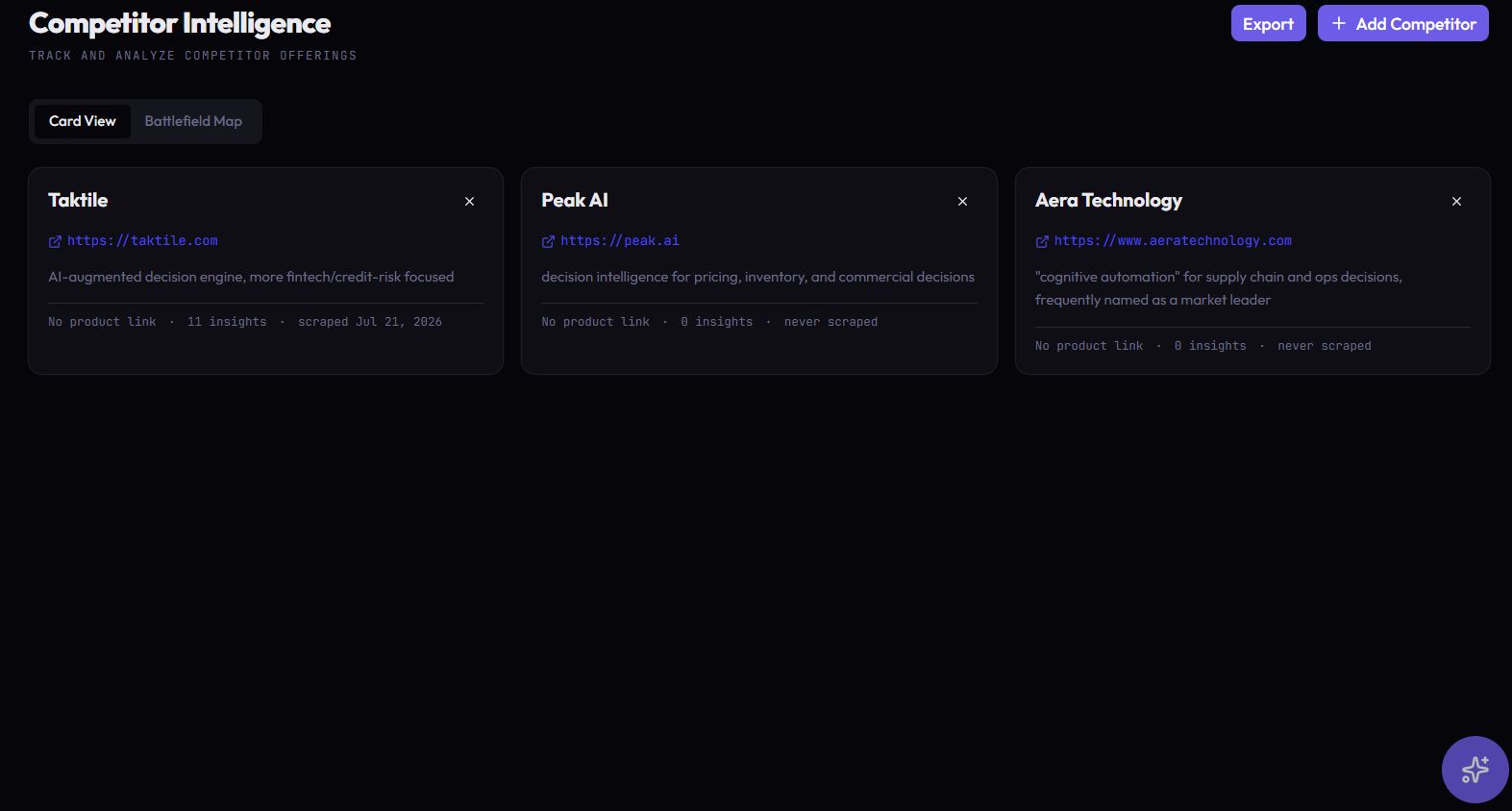
It's worth calling out why competitor tracking sits inside the same workspace as templates and campaigns rather than as a separate research tool. Positioning doesn't hold still. A competitor changes their pricing, ships a feature that closes a gap, or shifts their messaging — and a battle card or landing page that doesn't reflect that within days is actively working against the sales and marketing team using it.
Because LaunchPad tracks competitors inside the same system that produces the content responding to them, a positioning shift doesn't require someone to notice it, write it up, and manually update every asset that referenced the old landscape. The tracking and the content production live in the same place, which is what makes the update actually happen instead of sitting on someone's to-do list.
Human approval stays in the loop, at every stage
None of this runs unsupervised. Every piece of content LaunchPad produces — a campaign, a social post, a blog draft, a landing page — is human-approved before it publishes. The blog CMS's approval workflow is the most visible example, but the same principle holds across every format: LaunchPad's job is to get a campaign from a blank page to a reviewable draft that's already on-brand and already accurate, not to publish without anyone checking.
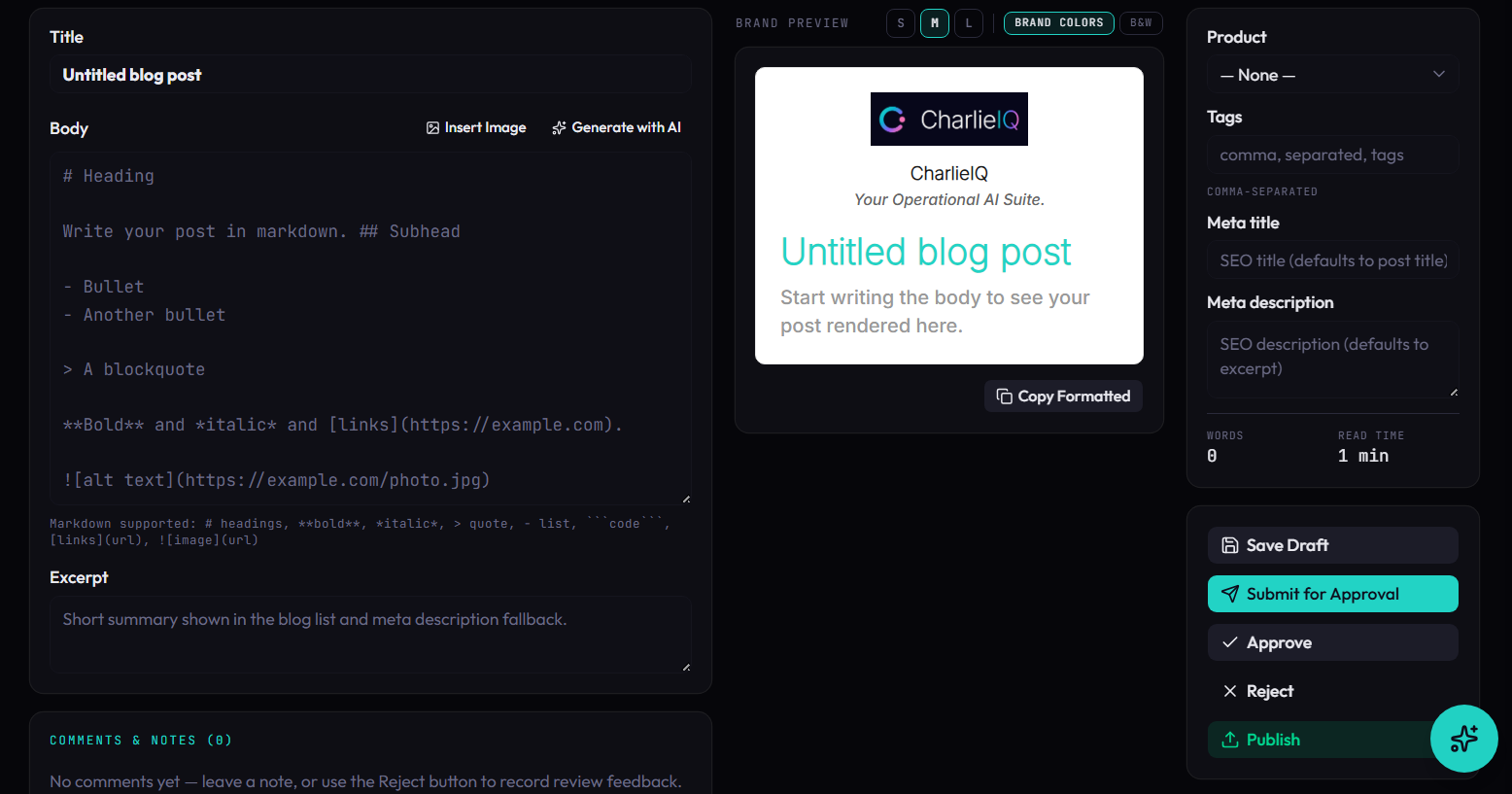
That's the actual value of grounding generation in Brand Kit and Knowledge Base from the start — it doesn't remove the human review step, it changes what that review step is for.
A marketer reviewing a LaunchPad draft isn't checking whether the colors are right or whether the feature claim is true. Those are already handled. What's left is the part that actually needs a person: does this message land, does this campaign make sense for this moment, is this the right thing to send.
The real test of "on-brand at scale"
The test of a brand system isn't whether it looks right on the first campaign. It's whether it still looks right on the two-hundredth, produced by a different person, for a different channel, under deadline. That's the scenario most style guides quietly fail, because consistency at low volume is easy and consistency at high volume is the actual problem worth solving.
Pairing a defined Brand Kit with a Knowledge Base that's actually current is what makes that hold at volume — not because someone's checking every asset by hand, but because drift never had a place to start.