The phrases "AI campaign manager" and "AI marketing agent" get used interchangeably. Here is how we draw the line, because the difference decides whether you are actually delegating work or just lengthening your approval queue.
In our view, an AI campaign manager plans, builds, schedules and reports. An AI marketing agent acts within limits you set. Most teams need both in one system: something that produces a whole campaign, and a clear rule for who decides what goes out.
What should an AI campaign manager handle?
A campaign manager turns an objective into an execution plan. It should not wait for instructions on every asset.
Take a goal like "Run a demo-request campaign for SaaS founders, with email and LinkedIn." A real campaign manager builds the structure around it: the email sequence, the social posts, the landing page, the blog support, and the timing across channels. It writes from your brand guidelines and your product knowledge, so every asset sounds like the same company. Then it tracks what happens and shows you what is working.
In LaunchPad, that job belongs to the AI Planner. It pulls your Brand Kit, your product Knowledge Base and the target persona, then writes the whole multi-channel sequence: subject lines, body copy, timing and platform choices. You can choose which Knowledge Base files a plan draws on, so a specific release note or spec drives the content.
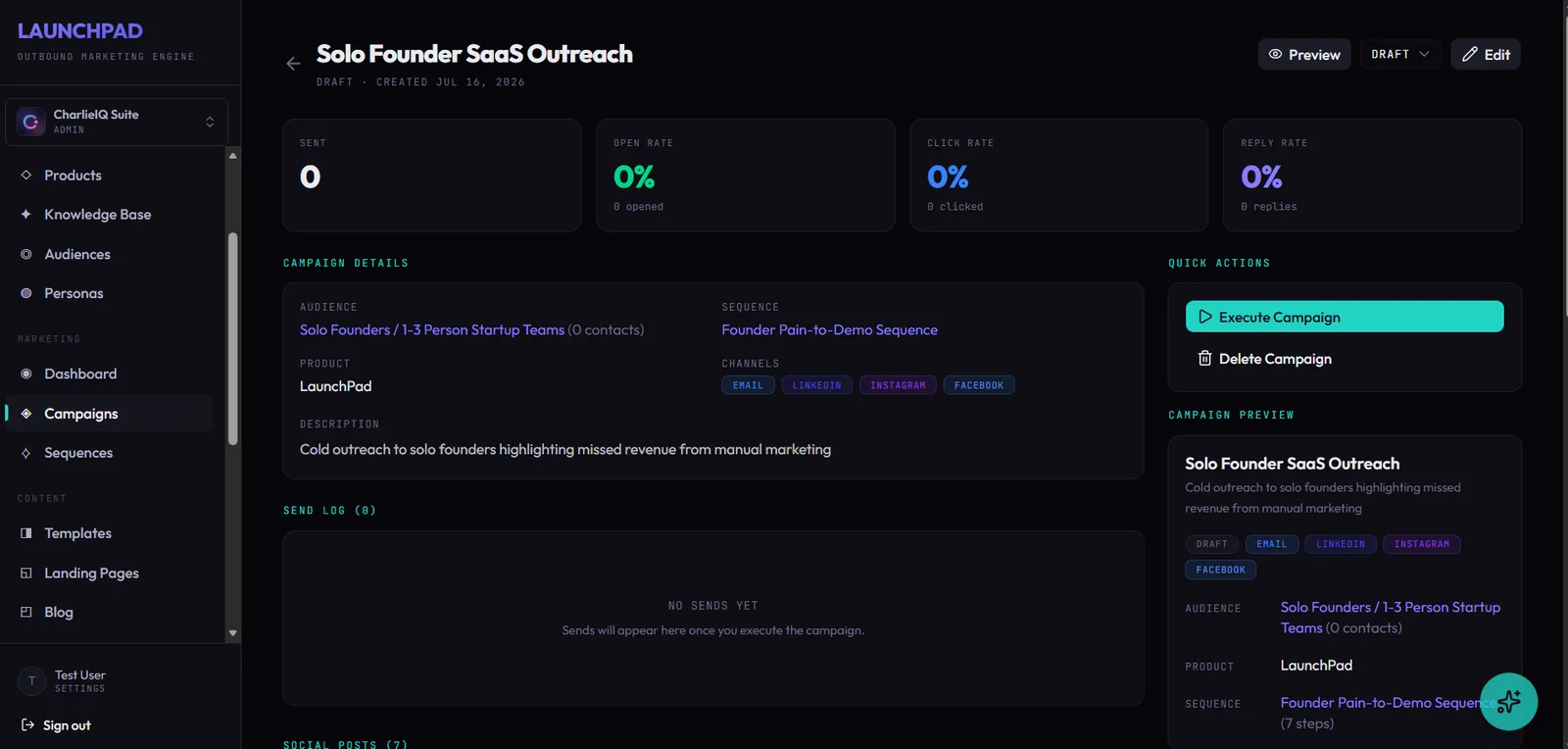
The output is a campaign you can review, not a pile of loose drafts.
What should an AI marketing agent do on its own?
An AI marketing agent should draft freely and publish only with approval. Speed matters, but only if a person stays in charge of what reaches your audience.
That means the approval workflow has to be part of the system, not something you bolt on afterward. In LaunchPad:
- Posts move through visible stages: Drafted, Pending Approval, Approved & Scheduled, Needs Changes, Rejected, and Published.
- Approval is a named responsibility. Designated reviewers approve, so it is never just whoever happens to be an admin.
- Any edit goes back for review, including a new scheduled time.
- Nothing posts without approval, and the blog CMS has its own approval workflow.
- LinkedIn publishing follows the same rule. Approved posts go out on schedule through your connected company Page. If LinkedIn does not confirm a post went through, LaunchPad holds it and asks you to check your Page first, so nothing posts twice.
Autonomy without guardrails is a brand risk. Autonomy with approval gates is leverage.
Where your attention should go
You do not need to read every subject line with the same care. You do need to read anything that touches pricing, customer claims or competitive positioning.
Grounding helps here. LaunchPad writes from your Knowledge Base and Brand Kit on every output, and it will not invent statistics, customers or pricing. When your documents cannot support a claim, the claim stays out. That changes what a reviewer is doing. Instead of hunting for invented facts, you are judging whether the message is right for this audience at this moment, which is the part that needs a person.
What to check before you buy
Whatever you evaluate, these questions separate a system that runs campaigns from one that produces drafts:
- 1. What does it write from? Your own documents and brand guidelines, or whatever the model defaults to?
- 2. What happens when it does not know? Does it leave the claim out, or fill the gap with something plausible?
- 3. Where does a human approve? Ask for the specific points, not "there is human oversight".
- 4. Does every channel read from the same source? If email, social and landing pages each start from a blank page, they will drift.
- 5. How will you know what worked? Look for results tied to the campaign: opens, clicks, bounces and channel results in one place.
What LaunchPad covers
LaunchPad is the AI marketing workspace inside CharlieIQ. It runs from one shared Knowledge Base and Brand Kit across:
- Multi-step sequences and campaigns, with open and click tracking
- Social posts across four platforms, with LinkedIn publishing built in
- Landing pages, exported as self-contained HTML files you can host anywhere
- A blog CMS with an approval workflow and version history
- Google Ads with trend-scored headlines
- Competitor tracking
- Podcasts
- An Artifacts Library of 18+ branded templates, as well as a custom artifact tool
A campaign analytics tab shows opens, clicks, bounces and LinkedIn results, with an AI wrap-up when a campaign finishes.
How LaunchPad fits with the rest of CharlieIQ
Marketing doesn't happen in isolation. The roadmap shapes launch timing. Sales needs messaging when a campaign goes live. Support needs updated answers when a feature ships. When each of those lives in a separate system, the handoffs create lag between what engineering ships and what the market hears.
CharlieIQ is an AI operational suite: Dispatch plans, Minions builds, LaunchPad markets, CallPilot sells, and Support Copilot serves. They share one context layer, so LaunchPad can have the announcement drafted the same day a feature merges. It still waits for your approval before anything goes out.
What to hand off, what to keep
Hand off the planning, drafting, scheduling and reporting. Keep authority over anything that ships.
An AI campaign manager should remove the grunt work: the asset creation, the calendar coordination, and the stitching together of analytics. An AI marketing agent should work fast inside limits you define once and adjust when strategy shifts. The goal is not to remove people from marketing. It is to give the structure to AI and keep the decisions that matter with you.
If you're ready to see how fast marketing moves when AI handles structure and you handle strategy, book a demo.
Frequently asked questions
What is the difference between an AI campaign manager and an AI marketing agent?
An AI campaign manager plans, builds, schedules, and reports on entire campaigns, while an AI marketing agent acts within limits you set and requires approval before publishing. Most teams need both in one system.
Does LaunchPad automatically publish content without human approval?
No. Nothing posts without approval in LaunchPad. Posts move through visible stages (Drafted, Pending Approval, Approved & Scheduled, Needs Changes, Rejected, and Published), and designated reviewers must approve every piece before it goes live.
What marketing channels does LaunchPad support?
LaunchPad supports multi-step email sequences with tracking, social posts including LinkedIn publishing, landing pages, a blog CMS with approval workflow, Google Ads, and competitor tracking.
How does LaunchPad prevent AI from inventing facts or statistics?
LaunchPad writes from your Knowledge Base and Brand Kit on every output and will not invent statistics, customers, or pricing. When your documents cannot support a claim, the claim stays out.
How does LaunchPad integrate with the rest of CharlieIQ?
LaunchPad shares one context layer with Dispatch (planning), Minions (code), CallPilot (sales), and Support Copilot (customer operations), so marketing announcements can be drafted the same day a feature merges, eliminating handoff delays between lifecycle stages.